Every online store works roughly the same way. A grid of products, a column of filters, a search bar, and a shopper who has to translate what they want into the categories the store offers.
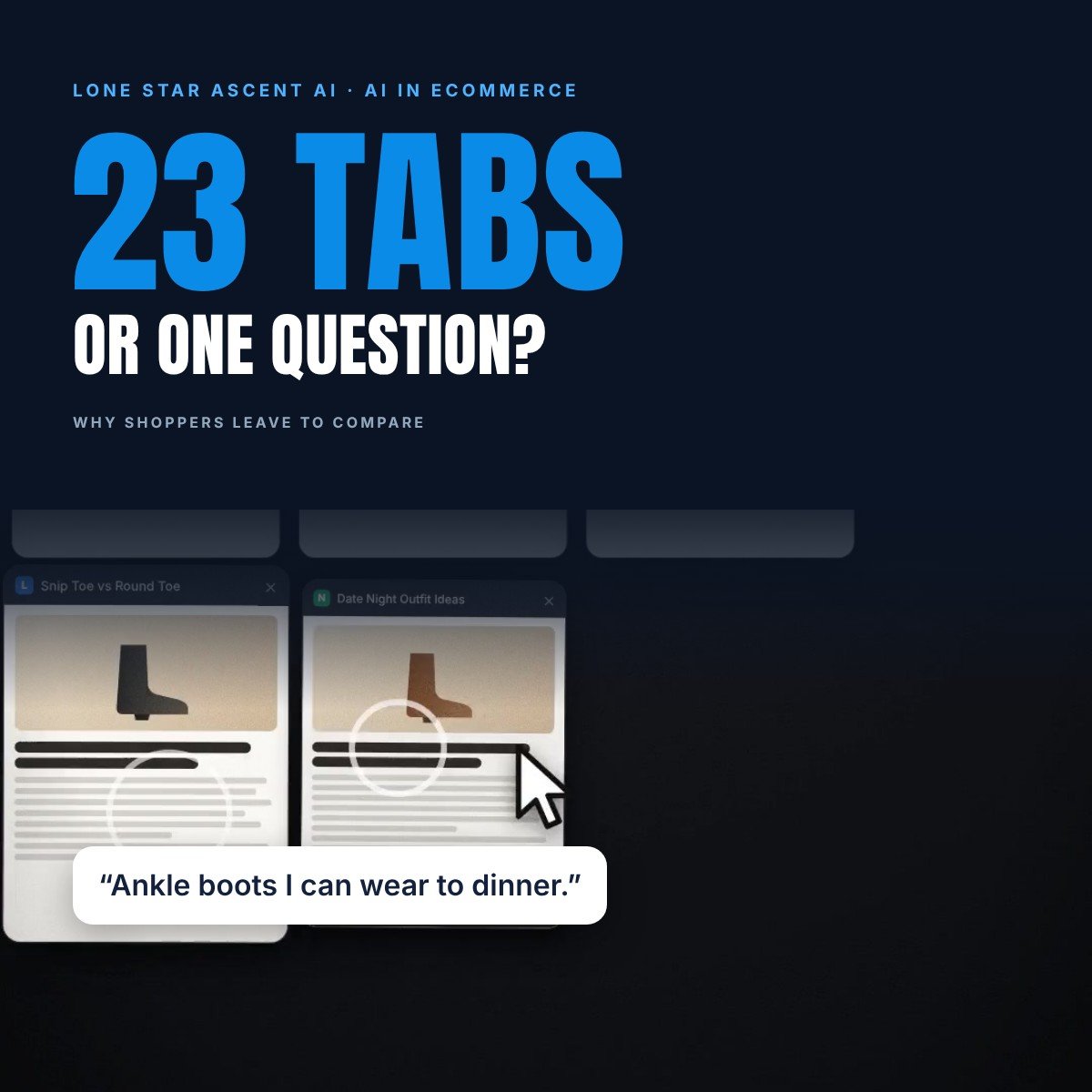
That translation is the work. A customer does not think "men's, size 10D, under four hundred dollars, snip toe, brown." They think "I need something for my sister's wedding that I can stand in all night." The store cannot accept that sentence, so the shopper breaks it into filters and loses most of the meaning.
Filters solved a real problem
This is not a criticism of e-commerce. Filters exist because catalogues got larger than any page could show, and they work. With ten thousand products and no salesperson, narrowing by attribute is a reasonable answer.
But it answers a problem the format created. A good salesperson never asks you to filter. They ask where you are wearing them.
What conversation restores
"Where are you wearing them?" carries more information than five filters. It implies formality, how long you will be on your feet, the weather, and what else you are wearing. A shopper answers it without effort, because it is how they already think about the purchase.
Removing filters is not about removing steps. It is about removing translation. The shopper says what they mean, and the system does the narrowing.
What gets harder
Two things, and it would be dishonest not to name them.
First, people do not know what to say. A blank prompt is harder than a filter list, because a filter list shows what is possible. Conversational shopping has to teach its own vocabulary in the first few seconds, or people leave without asking anything.
Second, browsing. Some shopping has no goal. People enjoy scrolling a catalogue with no plan to buy, and conversation is poorly suited to that. Any serious version has to keep a way to simply look.
Where this is going
The shift is not from clicking to talking. It is from the shopper doing the translation to the system doing it. Voice is one way in, typing is another. What matters is that the input can be a whole sentence with context in it.
Retail spent twenty years teaching customers to think in filters. The interesting work now is teaching systems to think in sentences.
We built this approach into Travis, a voice-first shopping assistant for the western boot brand Alvies.
Frequently asked questions
What is conversational commerce?
Conversational commerce is online shopping where the customer describes what they want in their own words and the system interprets it, instead of the customer choosing from filters and categories. It can be voice, text, or both.
Is voice shopping better than filtering?
It is better for goal-directed shopping, where the customer knows the occasion but not the product. It is worse for browsing, where the customer wants to look with no specific goal. Good implementations keep both.
Why do people struggle with conversational shopping?
A blank prompt gives no hint of what is possible, while a filter list does. Customers arrive without a vocabulary for the system and often leave without asking anything. Teaching that vocabulary quickly is the main design problem in the category.
What does Lone Star Ascent build?
Lone Star Ascent builds voice-first conversational shopping experiences for retail brands, where customers describe what they need and the system finds it. Travis, built for the boot brand Alvies, is the first live implementation.